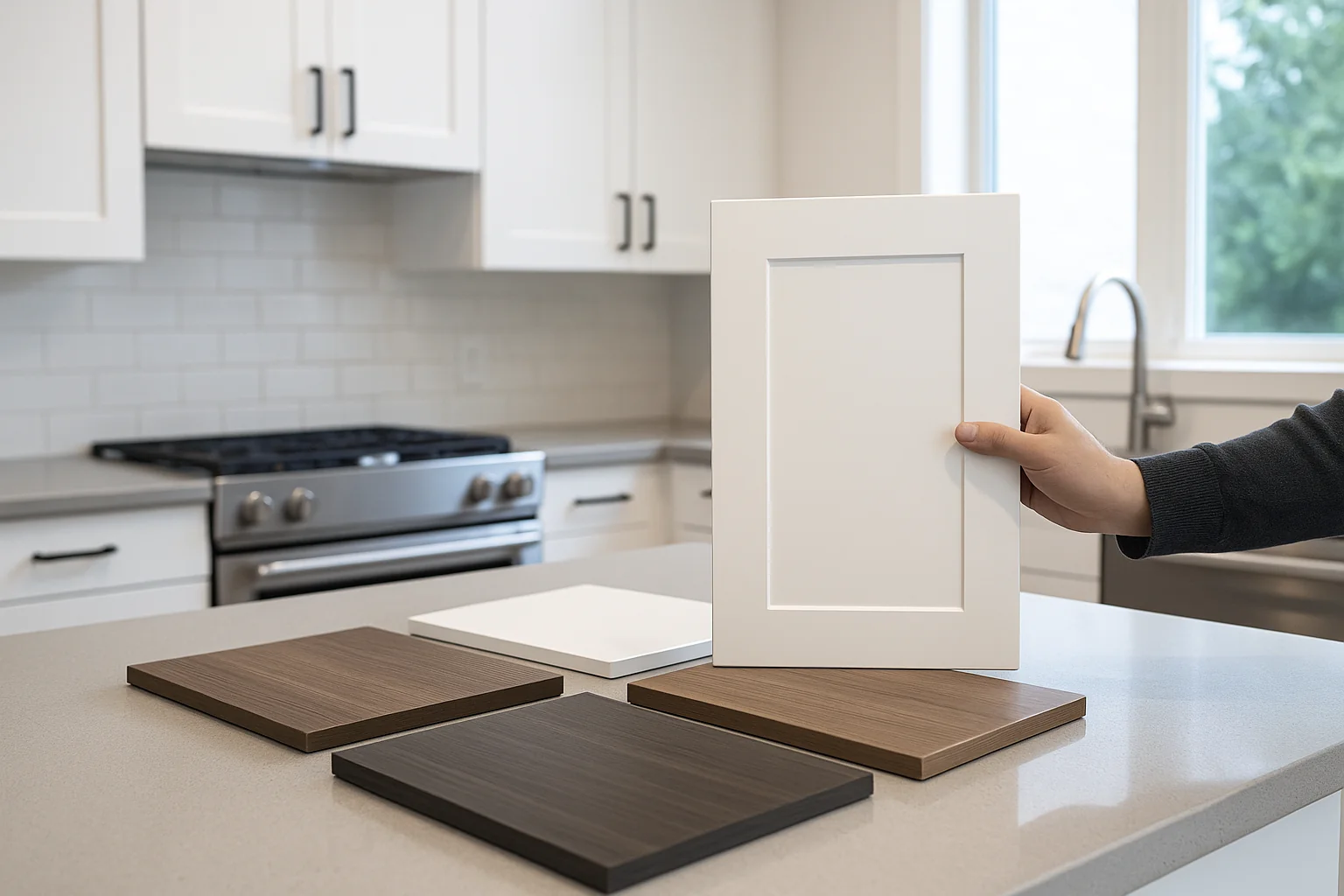
Like the MDF question, this one mixes up two different things. Plywood is a structural core — the material a cabinet box or door blank is built from. TFL is the finished surface fused on top. You can absolutely have a plywood-cored panel with a TFL surface, so in practice they work together: plywood does the structure, TFL does the face.
We build TFL doors in Alabama, and folks planning a full cabinet project ask this a lot, especially about boxes. The trick is knowing which part of the kitchen each one is for.
What Is TFL (Thermally Fused Laminate)?
TFL is Thermally Fused Laminate — a decorative surface fused onto a core with heat and pressure. It is the finish, not the structure. The core beneath it is usually MDF or particleboard, though laminate surfaces can go over plywood too.
TFL's job is to give you a durable, sealed, good-looking face in hundreds of colors and woodgrains. Whether the panel underneath is plywood, MDF, or particleboard is a separate decision about strength, weight, and cost.
What Is Plywood in Cabinets?
Plywood is built from thin wood veneers glued in cross-grain layers, which makes it strong, light for its strength, and excellent at holding screws. That is why plywood is a favorite for cabinet boxes — the structural part that carries weight and takes the fasteners.
But plywood is a core, not a finished face. On its own it still needs a surface: veneer, paint, or a laminate like TFL. Plywood also costs more than MDF or particleboard, and its surface is not as perfectly smooth for a painted or laminated look. Where plywood shines is structure and moisture resistance, not the visible finish.
TFL Finish vs Plywood Core
| Feature | TFL (Thermally Fused Laminate) | Plywood |
|---|---|---|
| What it is | A finished surface (fused laminate) | A structural core made of layered veneers |
| Role | The visible, durable face | The strength and screw-holding structure |
| Screw-hold | Depends on the core underneath | Excellent; ideal for cabinet boxes |
| Moisture | Sealed surface resists splashes | Handles moisture better than particleboard |
| Smooth finish | Perfectly smooth fused surface | Surface needs a finish applied over it |
| Weight | Adds essentially none | Lighter than particleboard for its strength |
| Cost | Affordable finished face | Pricier core than MDF/particleboard |
| Best use | The door and cabinet faces | The cabinet boxes and structure |
Bottom line: For doors, TFL gives the durable face; for boxes, plywood is a strong core choice. They solve different parts of the same kitchen rather than competing.
Pros & Cons of Each
TFL Pros
- Durable, sealed, finished surface
- Hundreds of colors and woodgrains
- Perfectly smooth face, no finishing needed
- Wipes clean and resists splashes
- Consistent look across every door
TFL Cons
- It is a finish, not a structural core
- Strength depends on the core it is fused to
Plywood Pros
- Excellent strength and screw-hold
- Great for cabinet boxes and structure
- Better moisture resistance than particleboard
- Light for its strength
Plywood Cons
- Needs a separate finished surface
- Costs more than MDF or particleboard
- Surface is not as smooth for finishing
- Not a decorative face on its own
Why Homeowners Choose TFL Doors from TFL Door
For the doors and faces people actually see and touch, TFL is the finish we build our whole shop around, and we back it:
- Limited Lifetime Warranty on every door
- Custom sizes at no upcharge
- Hundreds of colors and woodgrains from Wilsonart, Funder, and other top mills
- Stable, sealed core options under the fused surface
- Low-VOC, CARB-compliant cores
- Made locally in Gardendale, Alabama
TFL or Plywood: How to Decide
For cabinet boxes that carry weight and take screws, plywood is a strong, moisture-tolerant core worth paying a bit more for. That is where plywood belongs.
For the doors and drawer fronts — the parts you see, touch, and clean every day — you want a durable finished surface, and that is exactly what TFL delivers. The two are not competing; they solve different parts of the same kitchen. If you want great-looking, low-maintenance doors, TFL is the answer.
Finish your cabinets the durable way. Explore TFL doors at tfldoor.com.
Frequently Asked Questions
Is TFL better than plywood?
They do different jobs. TFL is a finished surface for doors and faces; plywood is a structural core for boxes. For the visible doors, TFL is the durable finish; for the boxes, plywood is a strong core.
Can you put TFL on plywood?
Yes. Laminate surfaces can be fused over various cores. In cabinet doors the core is most often MDF or particleboard, but the concept is the same: TFL is the finish on top.
Is plywood better for cabinet boxes?
For boxes, plywood is an excellent choice thanks to its strength, screw-hold, and moisture resistance. It is the finish over it that determines the look.
Which costs more, TFL or plywood?
Plywood is a more expensive core than MDF or particleboard. TFL is the finished surface and is very cost-effective for the face of the door.
Ready to Upgrade Your Cabinets Without Replacing the Boxes?
- Measure once
- Order online or by phone
- Install in a weekend
Browse Our Full Collection of TFL Door Styles
Questions about your specific project? Call or text us anytime at (205) 222-6866—we are real people who love talking cabinet doors.
Browse Door Styles | TFL vs Particle Board | TFL vs MDF | Contact Us