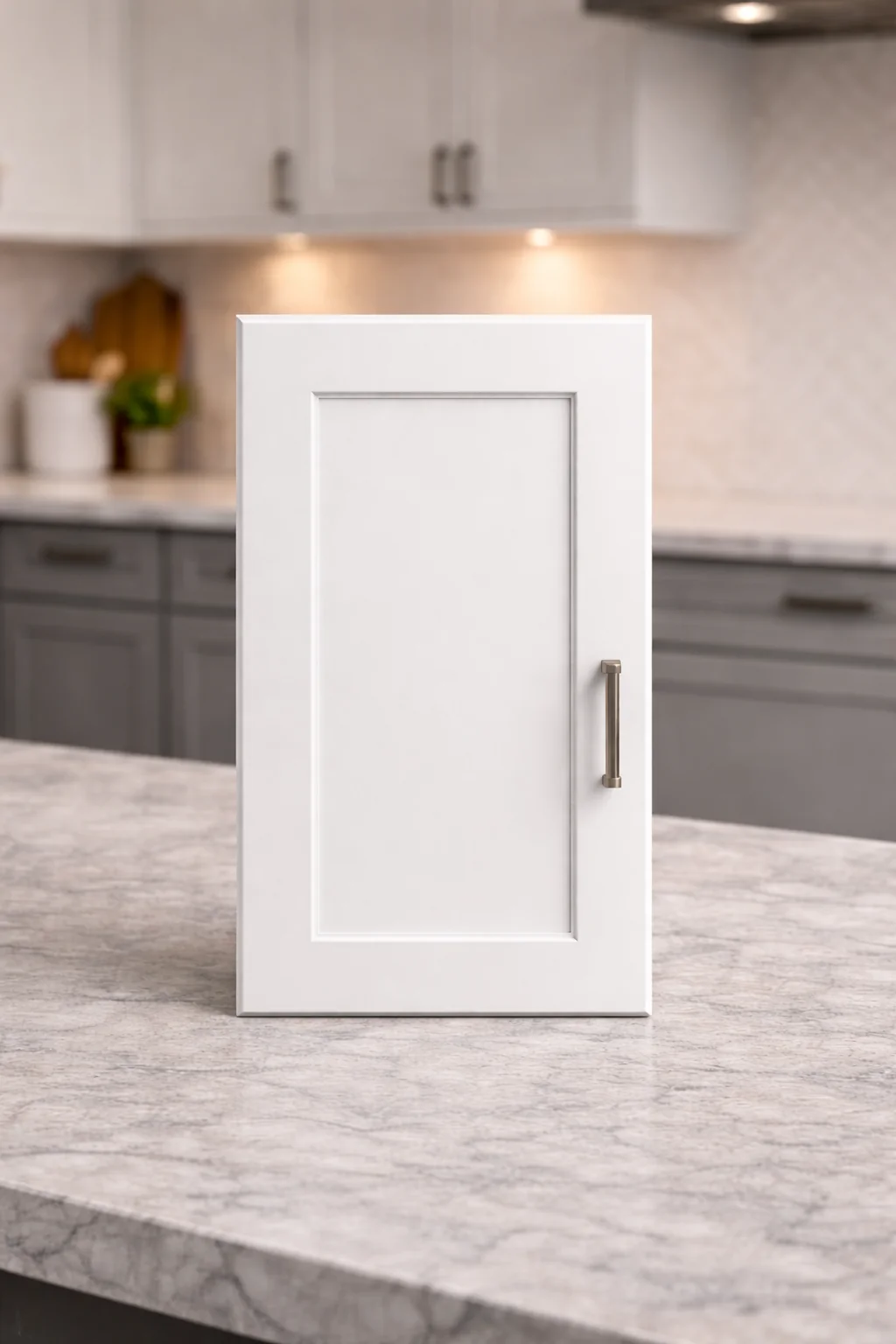
Particle board has a bad reputation from cheap flat-pack furniture, so people get nervous when they hear it is under their cabinet doors. Here is the thing worth knowing up front: particle board is a core material, and TFL is the finished surface fused onto it. Plenty of TFL doors are built on a particleboard core, and that combination is a lot better than bare particle board alone.
We build TFL doors in Gardendale, Alabama. It is worth understanding what particle board actually is, and why a fused surface changes the equation.
What Is TFL (Thermally Fused Laminate)?
TFL is Thermally Fused Laminate — a decorative surface fused onto a core under heat and pressure. That core is frequently high-quality particleboard, and the fused laminate seals it completely: face, and with edgebanding, the edges too.
That sealing changes everything. Bare particle board is vulnerable to moisture, but once a quality laminate is fused over it and the edges are banded, you get a stable, sealed, good-looking door. The surface does the protecting; the core keeps the cost down.
What Is Particle Board?
Particle board is an engineered core made from wood chips and particles bonded with resin and pressed into a flat, smooth, low-cost panel. It is stable, it is affordable, and it is smoother than you might expect — which is exactly why it makes a good base for a laminate surface.
Its weaknesses only show when it is left exposed. Bare or unsealed particle board can swell if water soaks into it, and raw edges are the most vulnerable spot. It also holds screws less firmly than plywood. But those are properties of unfinished particle board. Sealed under a fused TFL surface with banded edges, the moisture problem largely goes away.
TFL Finish vs Bare Particle Board
| Feature | TFL (Thermally Fused Laminate) | Particle Board |
|---|---|---|
| What it is | A finished surface fused on top | A low-cost engineered core |
| Moisture (sealed) | Fused surface seals the panel | Bare board swells if water soaks in |
| Edges | Sealed with color-matched banding | Raw edges are the vulnerable spot |
| Screw-hold | Fine for doors and fronts | Weaker than plywood for structure |
| Surface look | Colors and realistic woodgrains | Plain; needs a finish over it |
| Stability | Flat and dimensionally stable | Stable and flat as a core |
| Cost | Great value finished door | Cheapest core material |
| Best use | Finished doors and fronts | An economical core, once sealed |
Bottom line: Bare particle board's moisture worry is real, but a TFL door seals that core under a fused surface with banded edges. You get affordability plus protection — not raw particle board.
Pros & Cons of Each
TFL Pros
- Fused surface seals the core
- Banded edges resist moisture
- Colors and realistic woodgrains
- Great value on a stable core
- Consistent finish on every door
TFL Cons
- Screw-hold depends on the core beneath
- Damaged doors are replaced, not refinished
Particle Board Pros
- Cheapest core material
- Flat, smooth, and stable as a base
- Ideal substrate for laminate surfaces
Particle Board Cons
- Bare board swells with water
- Raw edges are vulnerable
- Weaker screw-hold than plywood
- Not a finished surface on its own
Why Homeowners Choose TFL Doors from TFL Door
The fear people have about particle board is really a fear of leaving it unsealed. Our TFL doors seal it properly, and we back them:
- Limited Lifetime Warranty on every door
- Custom sizes at no upcharge
- Quality sealed cores under a fused laminate surface
- Color-matched edgebanding to seal the edges
- Low-VOC, CARB-compliant cores
- Made locally in Gardendale, Alabama
TFL or Particle Board: What to Know
If someone offers you bare, unfinished particle board doors, the moisture concern is fair — that is where the material's bad reputation comes from. Exposed edges and spills are its enemy.
But a TFL door is not bare particle board. It is a sealed, finished door that happens to use an affordable, stable core under a tough fused surface. That is how you get durability and a great look without paying for solid wood or plywood everywhere. For doors and fronts, it is a smart, honest value.
Get a sealed, finished door for less. Explore TFL doors at tfldoor.com.
Frequently Asked Questions
Is TFL just particle board?
No. TFL is a fused laminate surface, and it is often applied over a particleboard core. The finished door is sealed and durable, not bare particle board.
Does particle board hold up in a kitchen?
Bare particle board can swell if water soaks in, especially at raw edges. Sealed under a fused TFL surface with banded edges, it holds up well for doors and fronts.
Is particle board or plywood better for cabinets?
Plywood has stronger screw-hold and is better for structural boxes. Particle board is a fine, economical core for doors and fronts once it is sealed with a laminate surface.
Why do TFL doors use a particleboard core?
It keeps the door affordable and is flat and stable. The fused TFL surface and edgebanding seal it, so you get value without giving up durability.
Ready to Upgrade Your Cabinets Without Replacing the Boxes?
- Measure once
- Order online or by phone
- Install in a weekend
Browse Our Full Collection of TFL Door Styles
Questions about your specific project? Call or text us anytime at (205) 222-6866—we are real people who love talking cabinet doors.
TFL vs MDF | TFL vs Plywood | Browse Door Styles | Contact Us