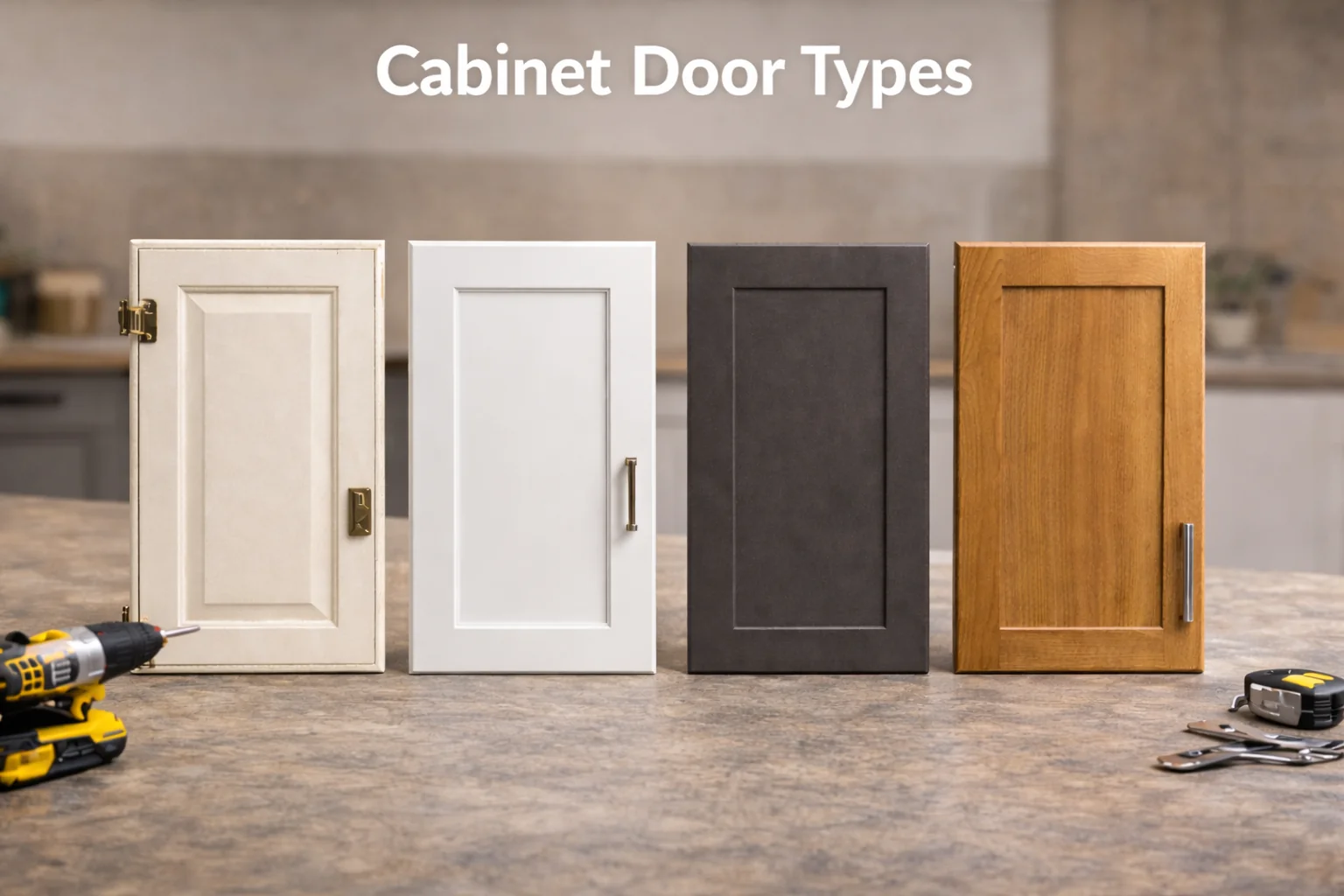
This is the big one. Solid wood has been the gold standard for cabinet doors for a hundred years, so it feels almost wrong to put a laminate up against it. But ask any cabinet maker what actually goes wrong with wood doors over time, and the answer is always the same three words: they move too much.
We build TFL cabinet doors here in Alabama, where summer humidity is no joke, so we have a front-row seat to how both materials behave. This is the fair version, wood's real strengths included.
What Is TFL (Thermally Fused Laminate)?
TFL stands for Thermally Fused Laminate. A decorative sheet — often a photographic woodgrain — is fused directly onto a dense MDF or particleboard core under heat and pressure. The finish and the board become one solid panel.
Because the core is engineered, a TFL door stays flat and dimensionally stable through humidity swings that make real wood expand, contract, and eventually crack its finish. What you gain is a door that looks like wood and behaves like something far more predictable.
What About Solid Wood Doors?
Solid wood doors are milled from real lumber — maple, oak, cherry, hickory — usually as a five-piece door with a frame and a panel. The grain is genuine, the material is beautiful, and it can be sanded and refinished decades from now.
The trade-off is that wood is a living material even after it is cut. It swells in humid months and shrinks in dry ones. Over the seasons that movement opens hairline gaps at the joints, cracks paint or stain at the panel edges, and can warp a door that was dead flat the day it was hung. It is also the most expensive way to build a door.
TFL vs Solid Wood: Head-to-Head
| Feature | TFL (Thermally Fused Laminate) | Solid Wood |
|---|---|---|
| Stability | Stays flat; barely reacts to humidity | Expands, contracts, and can warp with the seasons |
| Finish over time | Color stays consistent, no cracking | Stain/paint can crack at joints and panels |
| Moisture near sinks | Handles steam and splashes well | Vulnerable at seams and end grain |
| Color consistency | Identical across every door | Natural variation, grain and tone differ |
| Refinishing | Not refinishable, but rarely needs it | Can be sanded and refinished later |
| Weight | Comparable; a solid slab can run heavy | Comparable; a five-piece door can be lighter than a slab |
| Cost | Budget-friendly | The most expensive door option |
| Lifespan look | Looks the same in 15 years | Ages and can show joint movement |
Bottom line: Real wood is gorgeous and refinishable, but it fights the kitchen environment its whole life. TFL gives you the wood look with none of the seasonal movement, for a fraction of the price.
Pros & Cons of Each
TFL Pros
- Stays flat through Alabama humidity
- Realistic woodgrains at a fraction of wood's cost
- No cracking or joint gaps over time
- Every door matches perfectly
- Wipes clean, no sealing or oiling
TFL Cons
- Cannot be sanded and refinished
- Very close but not literally real wood grain
Solid Wood Pros
- Genuine, one-of-a-kind wood grain
- Can be refinished decades later
- Timeless, high resale appeal
- Repairable dings with wood filler
Solid Wood Cons
- Warps, swells, and shrinks with humidity
- Finish can crack at joints and panels
- Highest price of any door type
- Natural color variation between doors
Why Homeowners Choose TFL Doors from TFL Door
For a real-world Alabama kitchen, we think engineered beats natural here, and we back every door:
- Limited Lifetime Warranty on every door we build
- Custom sizes with no upcharge
- Realistic woodgrains from Wilsonart, Funder, and other top mills
- Rock-solid dimensional stability in humidity
- Low-VOC, CARB-compliant cores
- Built locally in Gardendale, Alabama
TFL or Solid Wood: The Honest Answer
If you want genuine wood you can refinish generations from now and the budget is there, solid wood is a legitimate choice with real charm. Just plan for seasonal movement and the maintenance that comes with it.
For most kitchens, TFL is the smarter pick. You get a convincing wood look, a door that stays flat and crack-free through humid Alabama summers, and a price that lets you redo the whole kitchen instead of just the doors.
Get the wood look that lasts. Explore our woodgrain doors at tfldoor.com.
Frequently Asked Questions
Is TFL as good as solid wood?
For durability in a kitchen, often better. TFL will not warp or crack at the joints the way wood can, and it costs far less. Solid wood's edge is that it uses genuine grain and can be refinished.
Does TFL look like real wood?
The best TFL woodgrains are photographic reproductions and look convincingly like real wood, with the bonus that every door matches perfectly instead of varying like natural lumber.
Do solid wood cabinet doors warp?
They can. Wood expands and contracts with humidity, which over time can warp doors and open small gaps at the joints. Engineered cores like TFL's stay far more stable.
Which is cheaper, TFL or solid wood?
TFL, by a wide margin. Solid wood is the most expensive door material, while TFL delivers a wood look at a budget-friendly price.
Ready to Upgrade Your Cabinets Without Replacing the Boxes?
- Measure once
- Order online or by phone
- Install in a weekend
Browse Our Full Collection of TFL Door Styles
Questions about your specific project? Call or text us anytime at (205) 222-6866—we are real people who love talking cabinet doors.
Browse Door Styles | TFL vs Wood Veneer | Order Samples | Contact Us