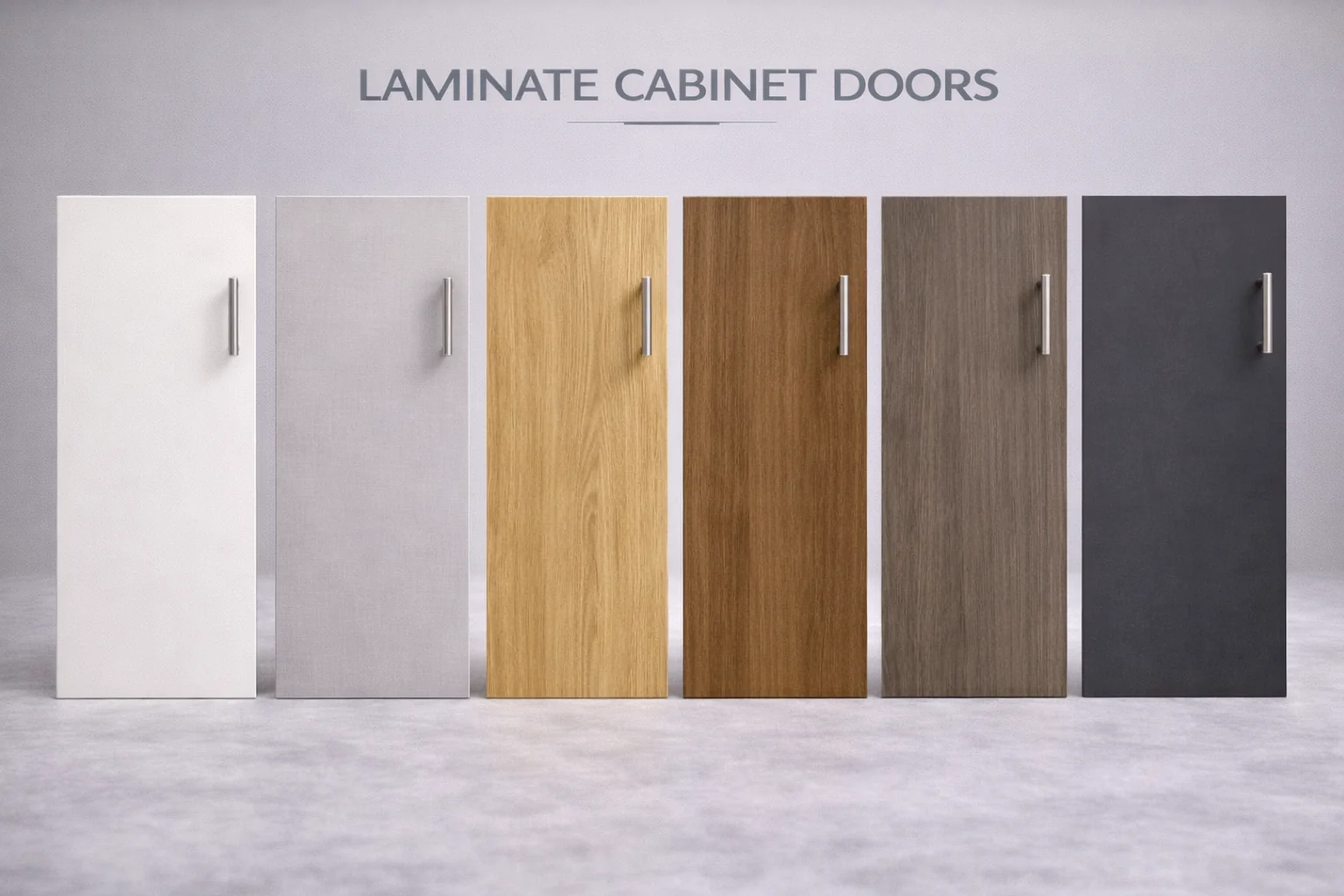
If you have shopped for laminate cabinet doors or countertops, you have probably run into two acronyms that get thrown around like they mean the same thing: TFL and HPL. They are cousins, not twins. The whole difference comes down to one thing—how the surface gets attached to the board underneath.
At TFLDoor.com we build Thermally Fused Laminate cabinet doors right here in Gardendale, Alabama, so we hear this one a lot: if HPL is the tougher countertop material, why not put it on doors too? Here is the straight answer, plus where each material actually earns its keep.
What Is TFL (Thermally Fused Laminate)?
TFL stands for Thermally Fused Laminate. A decorative paper soaked in melamine resin is bonded straight onto a particleboard or MDF core with heat and pressure. There is no glue involved—the resin and the board fuse into one panel.
Because the surface is fused to the board instead of layered on top, a TFL door is a single integrated piece. Nothing sits on the surface waiting to peel or lift down the road. That is what makes it a dependable pick for cabinet doors, and why the color and grain stay consistent across every door in the kitchen.
What Is HPL (High Pressure Laminate)?
HPL is the material most people already know as countertop laminate—Formica is the classic brand name. Several layers of kraft paper plus a decorative sheet are saturated with resin, then pressed together under very high pressure and heat into one rigid sheet.
Here is the key part: that sheet is made on its own, then glued to a substrate in a second step. The extra layers give HPL a thicker wear surface, which is exactly what you want on a countertop that takes knives, hot pans, and daily scrubbing. The trade-off is cost, weight, and a glue line that has to hold for the life of the piece.
TFL vs HPL: Head-to-Head
| Feature | TFL (Thermally Fused Laminate) | HPL (High Pressure Laminate) |
|---|---|---|
| Construction | Decorative paper fused directly to the board, no glue | Resin-saturated layers pressed into a rigid sheet, then glued on |
| Glue line | None; the surface is part of the panel | Adhesive bond that can fail over decades |
| Wear resistance | Excellent for doors and cabinet boxes | Slightly higher; built for countertops and commercial use |
| Best use | Cabinet doors, boxes, shelving | Countertops, worktops, heavy horizontal surfaces |
| Cost | Lower; the panel arrives already finished | Higher; extra sheet plus lamination labor |
| Weight added | Negligible | Adds a laminate sheet on top of the core |
| Edges | Color-matched edgeband | Edgeband or postformed |
| Lifespan on doors | 20+ years with normal care | Comparable, but the glue line is the weak point |
Bottom line: On a countertop, HPL's thicker wear layer earns its price. On cabinet doors, TFL matches it where it counts, skips the glue line that can delaminate, and costs less.
Pros & Cons of Each
TFL Pros
- No glue line to peel or delaminate
- Lower cost than a glued HPL panel
- One integrated panel, color-matched across every door
- Deep, realistic wood grains and solid colors
- Strong scratch and heat resistance
TFL Cons
- Edgeband is visible, though color-matched
- A hair less abrasion resistance than HPL on hard horizontal abuse
HPL Pros
- Highest surface abrasion resistance
- Can be postformed for seamless countertop edges
- Proven on commercial and high-traffic worktops
HPL Cons
- Costs more to buy and apply
- Glue line can delaminate over the years
- Overkill on vertical door surfaces
- Heavier panel
Why Homeowners Choose TFL Doors from TFL Door
We think TFL is the better everyday choice for Alabama kitchens, and we put our money behind it:
- Limited Lifetime Warranty on every door we make
- Custom sizes at no upcharge
- Hundreds of colors and realistic wood grains from Wilsonart, Funder, and other top mills
- Fast turnaround for quick remodels
- Low-VOC and CARB-compliant cores for a healthier home
- Built locally in Gardendale, Alabama
TFL or HPL: Which Should You Buy?
For cabinet doors and boxes, TFL is the practical winner. You get durability that stands up to real kitchen life, no glue line to worry about, realistic wood grains, and a lower price than a glued HPL panel.
HPL still has its place. If you are speccing a countertop, a workshop bench, or a commercial surface that takes constant abrasion, that thicker wear layer is worth paying for. Just do not pay the HPL premium on doors, where TFL already does the job.
Upgrade your cabinets the smart way. Shop TFL doors today at tfldoor.com.
Frequently Asked Questions
Is TFL the same as HPL?
No. Both use melamine resin and decorative paper, but HPL is a separate rigid sheet glued onto a board, while TFL is fused directly to the board in one step with no glue line.
Is HPL more durable than TFL?
HPL has a slightly tougher wear layer, which matters on countertops. On cabinet doors the difference is minor, and TFL avoids the glue line that can eventually delaminate.
Which is cheaper, TFL or HPL?
TFL. The panel arrives already laminated, so you skip the extra sheet and the lamination labor that HPL requires.
Should I use HPL or TFL for cabinet doors?
For doors, TFL is the practical pick: comparable durability, no delamination risk, and a lower cost. Save HPL for countertops and heavy horizontal surfaces.
Ready to Upgrade Your Cabinets Without Replacing the Boxes?
- Measure once
- Order online or by phone
- Install in a weekend
Browse Our Full Collection of TFL Door Styles
Questions about your specific project? Call or text us anytime at (205) 222-6866—we are real people who love talking cabinet doors.
View Color Options | Order Samples | TFL vs Thermofoil | Contact Us