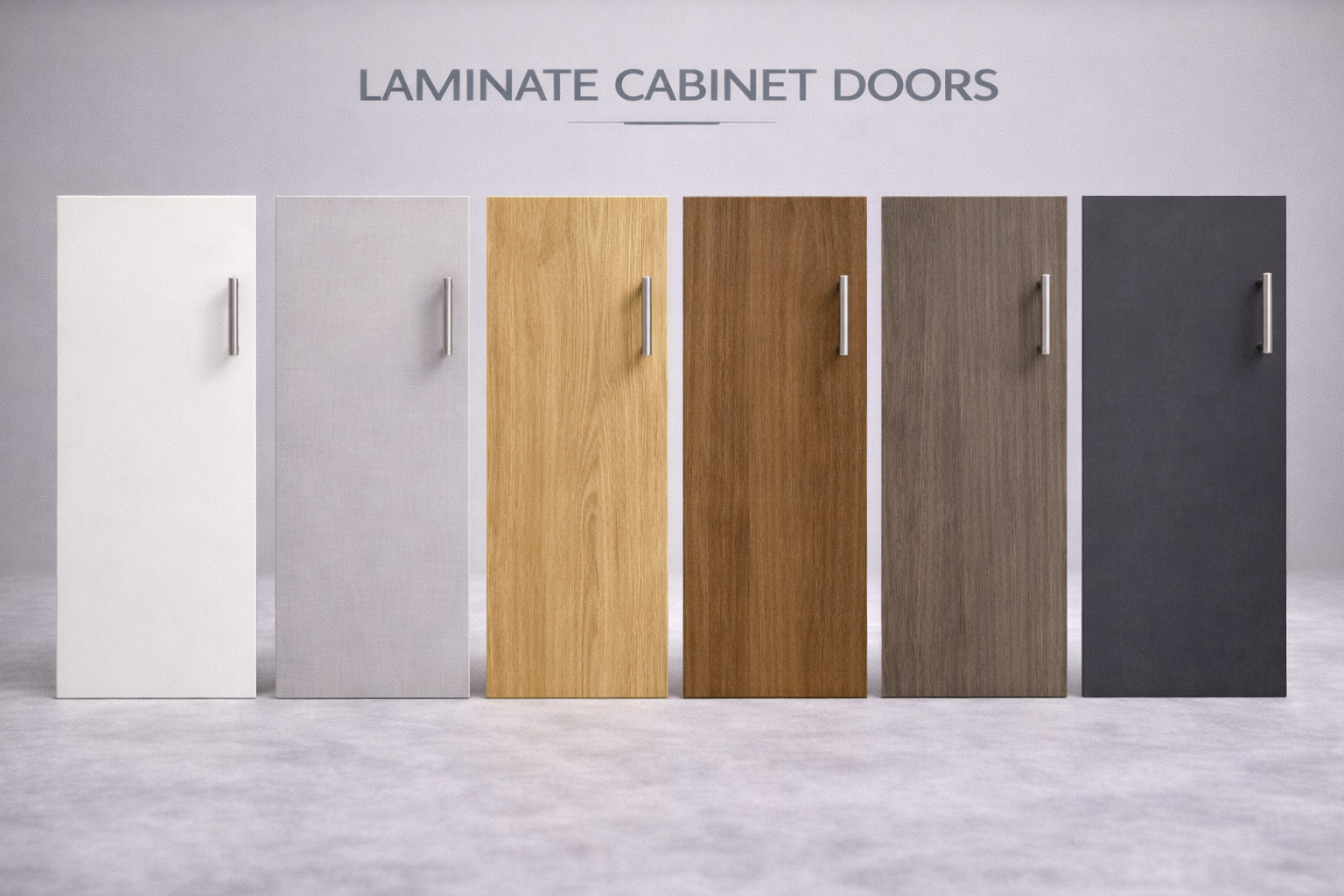
Homeowners comparing HPL vs melamine are usually trying to avoid two mistakes: paying countertop prices on doors, or buying flimsy big-box melamine that chips at the edge.
TFL Door manufactures 3/4" thermally fused laminate doors in Gardendale, Alabama—fused like melamine, finished like premium furniture laminate, without gluing a separate HPL sheet. Here is how high-pressure laminate stacks up against melamine board on the doors you actually touch every day.
This guide is written for real remodel decisions—not catalog trivia. We focus on vertical cabinet doors because that is what we build: 3/4" thermally fused laminate doors manufactured in Gardendale, Alabama, with decorative papers from Wilsonart, Formica, EGGER, ARAUCO, Uniboard, Kronospan, and partner mills. When a finish wins on countertops but loses on doors, we say so. When commodity melamine is enough for a laundry room, we say that too. Use the comparison table and FAQs as a checklist, then validate your sizes and decor on pricing or in the shop before demo day.
Melamine Board Basics
Melamine panels are low-pressure laminate (LPL): decorative paper saturated with melamine resin, bonded to particleboard or MDF. The face is fused at the mill, so there is no field-applied glue line on the show surface.
Commodity melamine optimizes price for closets and cabinets. Overlay weight, press quality, and edgeband matching vary by mill—reason many remodelers step up to TFL when the kitchen is the focal point.
HPL Sheet Laminate Basics
High-pressure laminate builds a thick, rigid sheet from kraft papers and a decorative layer, then laminators glue that sheet to a substrate. Brands like Formica and Wilsonart built their reputations on HPL counters and commercial surfaces.
That glue line is acceptable on a counter with postformed nosing. On a vertical door it becomes a long-term risk if steam, cleaning solution, or impact compromises the edge.
Performance on Vertical Doors
HPL wins abrasion tests in the lab, but cabinet doors rarely see the same abuse as a worktop. Day-to-day door life is fingerprints, occasional bumps, and wipe-downs—where fused melamine-family surfaces excel.
Thermally fused laminate (TFL) closes the gap: heavier overlay than commodity melamine, same fused construction, decorative collections from Wilsonart, Formica, EGGER, ARAUCO, Uniboard, and Kronospan.
Cost and Fabrication Reality
HPL pricing on doors includes sheet goods, adhesive, press time, and scrap from two-step processing. Melamine and TFL arrive as finished panel stock ready to cut, edge, and bore.
For a full kitchen of replacement doors, that labor difference shows up in quotes—not as a line item you always see, but in why door specialists standardize on TFL instead of field-laminated HPL.
Why Architects Still Spec HPL
Commercial specs reference HPL because decades of abuse data exist for hospital counters, retail checkout lanes, and lab benches. The thick wear layer is measurable and standardized—important when a facility manager needs predictable replacement cycles.
Residential kitchens are not commercial counters. Doors move, but they do not take knife cuts or sliding boxes hour after hour. That is why many residential door manufacturers standardized on fused panel stock decades ago.
When an architect drops HPL on a door schedule, ask whether the spec is legacy boilerplate. Substituting TFL with comparable wear ratings often satisfies intent while eliminating field lamination.
Installation and Shop Throughput
A shop laminating HPL onto custom door sizes needs press tables, adhesive open time, trim cleanup, and rework when bubbles appear. TFL and melamine shops skip that station entirely—CNC cut, edge, bore, ship.
For homeowners buying direct, the difference shows up as fewer failure modes and faster consistency across a big order. You are not waiting for a laminator to finish a batch before your shaker stiles get bored for hinges.
We keep the process door-focused in Gardendale: fused panel in, finished 3/4" door out, with the same construction whether you ordered twenty slabs or two glass-ready frames.
Care and Cleaning Compared
Melamine and TFL clean with soft cloths and non-abrasive kitchen cleaners. Avoid steel wool on any decorative surface. HPL on doors tolerates similar cleaning if edges remain sealed—once water tracks into the glue line, neither HPL nor melamine can rescue a swollen core.
Heat advice is straightforward: maintain manufacturer clearances to ovens and use ventilation. No cabinet finish loves sustained 400°F air blasting the same spot.
If you already have HPL-laminated doors that are peeling at the bottom rail, replacement TFL doors are often the most rational fix—you gain fused faces without repeating the glue-line mistake.
Measuring, Hinges, and Field Fit
Replacement doors only look professional when overlay, reveal, and hinge boring match your existing boxes. Measure width and height on multiple points—old cabinets are rarely perfectly square. Note whether you have concealed European hinges or face-frame overlays because hole patterns must match or you will re-drill carcases.
Three-quarter-inch TFL doors from TFL Door use standard boring layouts compatible with common hinge plates, but always verify your current cup distance and overlay before submitting sizes on the pricing page. Keep one old door as a template until the new shipment arrives.
If you are working with a contractor in Birmingham, Huntsville, or anywhere we ship, send them the decor code and thickness spec early so trim carpenters plan consistent reveals. Miscommunication on thickness is a common reason doors feel wrong even when color is perfect.
Climate, Cleaning, and Long-Term Appearance
Alabama humidity swings mean ventilation matters more than mystic finish claims. Wipe spills promptly, use range hoods, and avoid draping wet towels over door faces. Fused melamine-family surfaces and quality edgeband tolerate normal kitchen life when edges stay sealed.
Cleaning is simple: soft microfiber, mild detergent, no abrasive pads on gloss-adjacent textures. Neither harsh chemistry nor magic sprays substitute for dry edges and proper sink caulk.
Sun fading can shift any material over years if intense UV hits the same door daily. Matte TFL grains hide micro-scratches better than high-gloss alternatives; if your kitchen gets afternoon sun, favor matte or soft-texture decors from Wilsonart, Formica, EGGER, ARAUCO, Uniboard, or Kronospan lines.
Working With TFL Door on Your Timeline
We manufacture in Gardendale rather than brokering imports—when you call (205) 222-6866 you reach people who touch the product. Use the online shop for straightforward reorders and the pricing configurator when you are validating budget before demo day.
Order samples before committing to a whole kitchen of one decor, especially when matching stone, tile, or LVP flooring. A sample board on the counter for three days prevents expensive regret.
Document your choices: decor code, edge color, door style, and hinge boring. Future additions (wine fridge surround, pantry, laundry) then reorder cleanly without guessing which batch you used in 2026.
Remodel Checklist Before You Order Doors
You searched HPL vs melamine because the finish choice is confusing and the stakes are high—kitchens are the most used room in the house. Before you compare brands on paper, walk the space and list what actually failed in the old kitchen: peel, chip, color fade, or just dated style.
Photograph every opening with a tape measure in frame. Note appliance clearances, especially wall ovens, refrigerators with deep handles, and trash pullouts that kiss door swings. A quarter-inch miscount multiplied across twenty openings becomes an expensive reorder.
Confirm your hinge brand and overlay. If you are switching from thermofoil builders-grade hinges to soft-close plates, buy hardware before doors arrive so installers are not guessing cup depth on install day.
Plan touch-up and spare strategy: store one extra door if you have young kids or large dogs; label it with decor code and order date in the garage. Reorder paths are smoother when you treat the kitchen like a long-life asset, not a one-year flip.
Finally, align expectations with whoever cooks in the house. The person maintaining the kitchen daily should veto gloss levels and dark colors that show every crumb. Practical buy-in beats the prettiest Pinterest board when Monday morning coffee spills happen.
Side-by-Side Comparison
| Feature | Melamine (LPL) | HPL (sheet laminate) |
|---|---|---|
| Manufacturing | Fused at panel mill | Sheet pressed, then glued in shop |
| Glue line on face | None | Yes—sheet to core |
| Abrasion rating | Moderate | Highest |
| Typical door use | Budget flats | Custom commercial (uncommon residential) |
| Edge treatment | PVC or melamine edgeband | Edgeband after lamination |
| Moisture sensitivity | Depends on core and edges | Glue line is weak point if water intrudes |
| Weight | Lighter | Heavier |
| Better upgrade path | TFL fused panels | TFL for doors; HPL for tops |
Pros & Cons
Melamine Pros
- Economical fused surface
- No separate lamination step
- Fast to fabricate doors
Melamine Cons
- Wear layer lighter than HPL
- Can look generic
- Edgeband quality matters
HPL Pros
- Extremely hard wear surface
- Familiar spec for architects
- Great on horizontal tops
HPL Cons
- Higher fab cost on doors
- Potential delamination
- Overkill for vertical use
Why Homeowners Choose TFL Doors from TFL Door
We build 3/4" thermally fused laminate cabinet doors in Gardendale, Alabama, with decorative papers from Wilsonart, Formica, EGGER, ARAUCO, Uniboard, Kronospan, and other leading mills:
- Limited Lifetime Warranty on every door we make
- Custom sizes at no upcharge
- Hundreds of colors and realistic wood grains
- Low-VOC and CARB-compliant cores for a healthier home
- Built locally in Gardendale, Alabama
Should You Choose HPL or Melamine for Doors?
Keep HPL on counters and heavy horizontal work. For cabinet doors, melamine-family TFL delivers fused durability without the sheet glue line. See TFL vs HPL for the full picture.
Configure your project at pricing or explore door styles—we build in Gardendale with the same 3/4" construction on every order.
If your contractor defaults to HPL out of habit, share this page and ask whether fused TFL panel stock meets the same design intent on vertical doors. You keep realistic grains, avoid a field glue line, and simplify fabrication in our Gardendale shop when you order through tfldoor.com.
Frequently Asked Questions
Is HPL stronger than melamine?
HPL has a thicker wear layer and higher abrasion resistance. On vertical doors that difference matters less than edge integrity and fused construction.
Can you make shaker doors from HPL?
Yes, but each component must be laminated or purchased as HPL-backed panel. TFL shaker doors are simpler because every stile and rail starts as fused stock.
Does melamine peel like thermofoil?
Quality fused melamine and TFL do not peel like PVC thermofoil. Failure modes are usually impact chips at edges, not wide surface delamination.
Is Formica HPL or melamine?
Formica sells both HPL sheets and TFL programs. The brand name alone does not tell you construction—check whether the product is a fused panel or a sheet laminate.
What does TFL Door use?
We build TFL doors on 3/4" cores with papers from Wilsonart, Formica, EGGER, ARAUCO, Uniboard, Kronospan, and partner mills.
How do I compare quotes?
Ask whether doors are fused TFL, commodity melamine, or field-laminated HPL. Then use our pricing tool with your exact sizes.
Ready to Upgrade Your Cabinets Without Replacing the Boxes?
- Measure once
- Order online or by phone
- Install in a weekend
Browse Our Full Collection of TFL Door Styles
Questions about your specific project? Call or text us anytime at (205) 222-6866—we are real people who love talking cabinet doors.