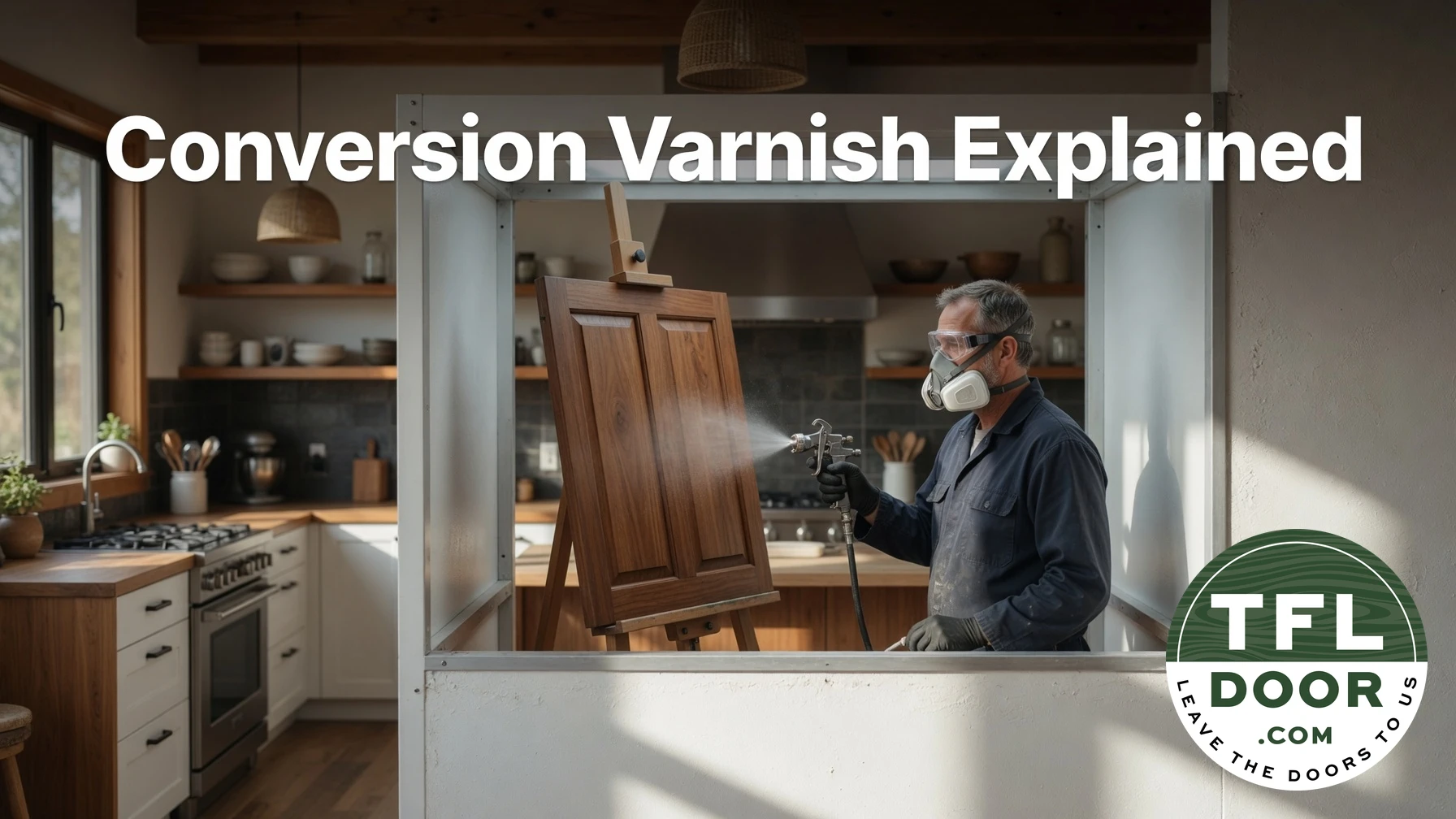
Conversion varnish has a strong reputation among cabinet pros as one of the toughest sprayed finishes you can put on wood. So how does it stack up against TFL, where the surface is fused into the door instead of sprayed on top? The answer comes down to a simple split: one is a coating over wood, the other is the surface itself.
We build TFL doors in Alabama, and we also have a full write-up on conversion varnish if you want the deep dive. For doors, the answer is less obvious than the varnish's reputation suggests.
What Is TFL (Thermally Fused Laminate)?
TFL is Thermally Fused Laminate. The decorative surface is fused onto an engineered core with heat and pressure, so the color and grain are the door, not a layer sprayed over it. There is no topcoat that can chip, yellow, or eventually need to be stripped and redone.
Because the finish is fused rather than applied, a TFL door skips the whole world of spray booths, cure times, and touch-ups. It arrives finished, stays consistent from door to door, and needs nothing but a wipe-down to keep looking new.
What Is Conversion Varnish?
Conversion varnish is a two-part, catalyzed finish sprayed onto wood or MDF doors and cured into a hard, chemical-resistant coating. Among traditional sprayed finishes it is genuinely tough — it resists moisture, kitchen chemicals, and daily wear better than standard lacquer, which is why high-end cabinet shops love it.
The trade-offs are that it is still a coating over a substrate, so it can chip at edges and will eventually show wear on a wood door that moves with humidity. Application is a skilled, multi-step process with real VOCs during spraying and curing, which adds cost and cure time. And like most sprayed finishes, an invisible repair is difficult once it is damaged.
TFL vs Conversion Varnish: Head-to-Head
| Feature | TFL (Thermally Fused Laminate) | Conversion Varnish |
|---|---|---|
| Finish type | Surface fused into the panel | Catalyzed coating sprayed on top |
| Chipping | Will not chip | Can chip at edges over time |
| Chemical/moisture | Sealed, wipes clean | Strong resistance for a sprayed finish |
| Repairability | Not needed for normal wear | Hard to repair invisibly |
| VOCs | No finishing VOCs; nothing sprayed | Real VOCs during spraying and curing |
| Consistency | Identical across every door | Depends on the sprayer's skill |
| Cost | Budget-friendly, arrives finished | Higher; skilled labor and cure time |
| Look | Colors and realistic woodgrains | Clear or tinted over wood grain |
Bottom line: Conversion varnish is a top-tier coating over wood, but it is still a coating — it can chip and is hard to repair. TFL fuses the surface in, so there is nothing to chip and no spraying required.
Pros & Cons of Each
TFL Pros
- Fused surface will not chip
- No spraying, curing, or VOCs
- Consistent finish on every door
- Wipes clean, no maintenance
- Budget-friendly and arrives finished
TFL Cons
- Cannot showcase a real wood grain under a clear coat
- Color-matched edgeband seam is visible
Conversion Varnish Pros
- Very durable for a sprayed finish
- Strong chemical and moisture resistance
- Shows off real wood under a clear coat
- Popular with high-end cabinet shops
Conversion Varnish Cons
- Still a coating that can chip at edges
- Hard to repair invisibly
- VOCs during spraying and curing
- Higher cost and cure time
Why Homeowners Choose TFL Doors from TFL Door
If you want durability without the spray booth, TFL delivers a finished door out of the box, and we back it:
- Limited Lifetime Warranty on every door
- Custom sizes at no upcharge
- Hundreds of colors and woodgrains from Wilsonart, Funder, and other top mills
- A fused finish with no VOCs and no chipping
- Low-VOC, CARB-compliant cores
- Made locally in Gardendale, Alabama
TFL or Conversion Varnish: Which Should You Choose?
If your heart is set on real wood doors and you want the toughest sprayed finish protecting that grain, conversion varnish is an excellent choice — it is one of the best coatings in the business. Read our conversion varnish guide for the full picture.
But if what you really want is a durable, low-maintenance door that will not chip and needs no spraying or curing, TFL is the simpler, more affordable answer. You get a finished surface that is part of the door, in more colors than a varnish shop would ever stock.
Durable, finished, ready to install. Shop TFL doors at tfldoor.com.
Frequently Asked Questions
Is TFL more durable than conversion varnish?
In different ways. Conversion varnish is a very tough coating, but it can still chip and is hard to repair. TFL fuses the surface into the door, so there is nothing to chip, and it needs no maintenance.
Does conversion varnish chip?
It is durable for a sprayed finish, but as a coating over a substrate it can still chip at edges and show wear over time, especially on wood doors that move with humidity.
Does TFL have VOCs like conversion varnish?
A fused TFL surface does not off-gas VOCs the way a sprayed, catalyzed varnish does during application and curing. Our cores are also low-VOC and CARB-compliant.
Which costs more, TFL or conversion varnish?
Conversion varnish typically costs more because it requires skilled spraying, multiple coats, and cure time. TFL arrives factory-finished at a budget-friendly price.
Ready to Upgrade Your Cabinets Without Replacing the Boxes?
- Measure once
- Order online or by phone
- Install in a weekend
Browse Our Full Collection of TFL Door Styles
Questions about your specific project? Call or text us anytime at (205) 222-6866—we are real people who love talking cabinet doors.
Conversion Varnish Guide | Browse Door Styles | TFL vs HPL | Contact Us