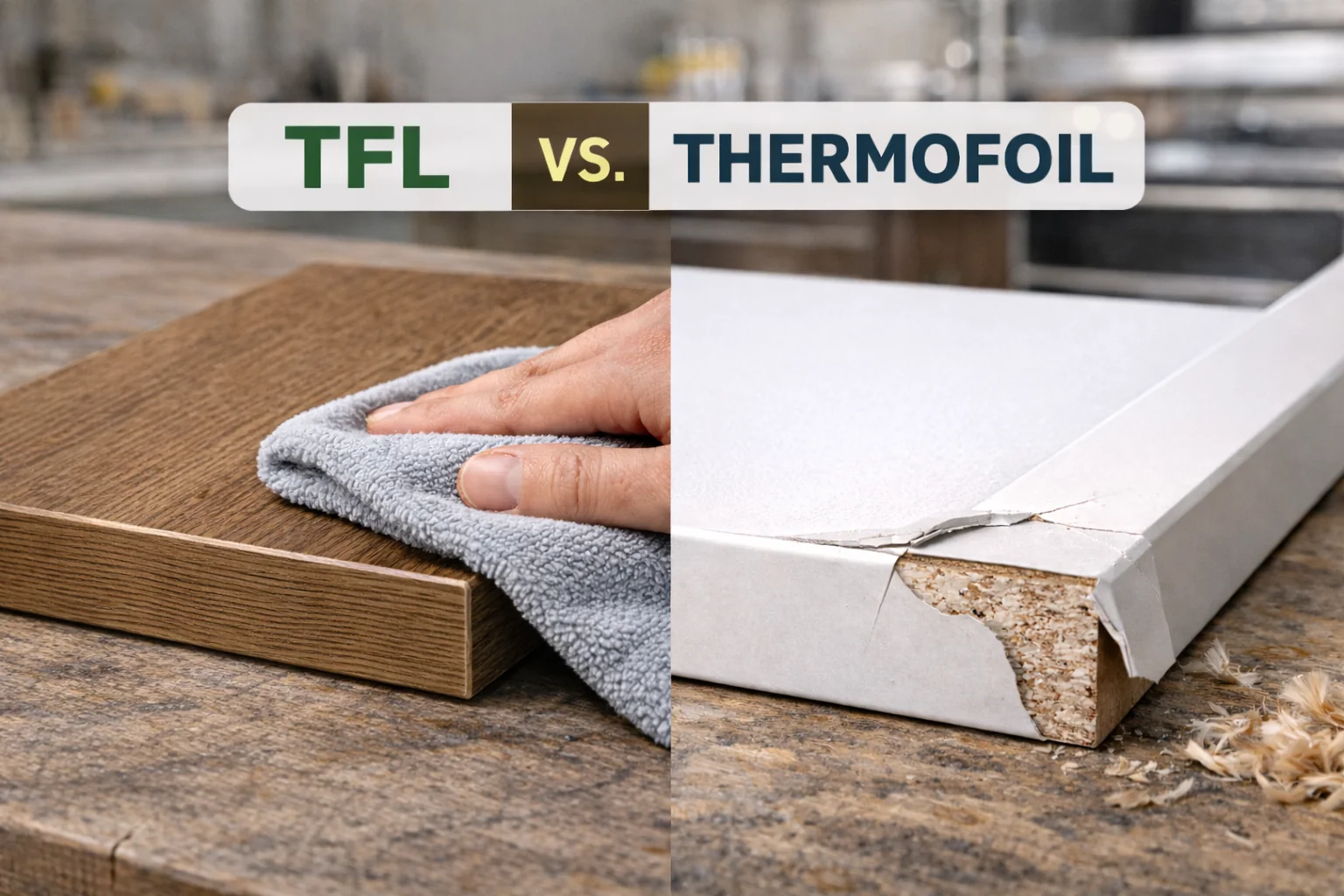
Confused about the difference between Thermally Fused Laminate (TFL) and Thermofoil cabinet doors? You're not alone. While both offer affordable alternatives to solid wood, they're manufactured completely differently and perform very differently in real-world kitchen environments.
At TFL Door, we've spent years manufacturing premium TFL cabinet doors right here in Central Alabama, and we've seen firsthand why TFL consistently outperforms thermofoil in durability, heat resistance, and long-term value. Let's break down exactly what sets these two materials apart.
Understanding TFL (Thermally Fused Laminate)
Thermally Fused Laminate uses an advanced manufacturing process where decorative paper—pre-saturated with melamine-formaldehyde resin—is bonded directly to an MDF or particleboard substrate using high heat and extreme pressure.
What makes this special? No adhesives are used. The intense heat triggers a chemical reaction that permanently fuses the decorative surface into the core material, creating what's essentially a single, integrated piece.
The benefits are clear:
- The bond is permanent and won't delaminate over time
- Surface is exceptionally resistant to scratches, impacts, and daily wear
- Heat-stable for use near stovetops and ovens
- Available in hundreds of realistic wood grains and modern colors
- Requires zero finishing—arrives ready to install
At TFL Door, our doors come in modern slabs, 3-piece contemporary styles, and classic 5-piece Shakers—all with that factory-perfect finish you can count on for 20+ years.
Understanding Thermofoil (RTF)
Thermofoil—also called Rigid Thermofoil or RTF—takes a completely different approach. A thin vinyl or PVC film is heated until pliable, then vacuum-pressed over a shaped MDF core in a process similar to shrink-wrapping.
How it works:
- The vinyl film wraps completely around the door front and edges
- Creates a seamless appearance with no visible edge banding on the face
- Works well for raised panels and detailed profiles
- Usually available in solid colors (whites, off-whites, gloss finishes)
The trade-offs:
- Vinyl can peel or bubble when exposed to heat from appliances
- More susceptible to scratches and scuffs over time
- Limited realistic wood-grain options compared to TFL
- Typically lasts 3-5 years before showing significant wear
The Real-World Performance Differences
| Performance Factor | Thermally Fused Laminate (TFL) | Thermofoil (RTF) |
|---|---|---|
| Manufacturing Process | Heat-pressure fusion (no adhesives) | Vacuum-wrapped vinyl film |
| Surface Appearance | Textured wood grains or smooth solids | Smooth, often glossy solid colors |
| Ideal Door Styles | Slabs, flat-panel, simple Shakers | Raised panels, ornate profiles, Shakers |
| Impact Resistance | Excellent—fused bond won't peel | Good, but vinyl can separate with impact |
| Heat Tolerance | Excellent near stovetops/ovens | Poor—heat causes bubbling/peeling |
| Moisture Performance | Very good (especially MR cores) | Moderate—seams can trap moisture |
| Daily Cleaning | Simple wipe-down, no texture grooves | Easy to clean, seamless surface |
| Price Point | Very affordable—often lower cost | Moderate—slightly higher than basic TFL |
| Expected Lifespan | 20-25+ years with proper care | 3-5 years typical |
| Edge Treatment | Color-matched edge banding (visible) | Fully wrapped—no edge banding on face |
The verdict: TFL delivers superior durability and heat resistance with beautiful wood-look options. Thermofoil works best when you need seamless painted-look doors with decorative profiles.
Making Your Decision: TFL or Thermofoil?
Choose TFL When You Want:
- Maximum durability and scratch resistance
- Heat-resistant doors near cooking surfaces
- Realistic wood grain textures and colors
- Long-term value (20+ year lifespan)
- Low maintenance wipe-clean surface
- Modern slab or simple Shaker styles
Best for: Kitchens, busy households, high-traffic areas, modern/contemporary designs
Choose Thermofoil When You Want:
- Seamless painted-cabinet appearance
- Raised panel or detailed profiles
- Traditional white/off-white finishes
- No visible edge banding on faces
- Smooth, uniform solid colors
Best for: Lower-traffic rooms, away from heat sources, traditional styles, painted-look cabinets
For most homeowners remodeling kitchens or high-use spaces, TFL offers unbeatable performance and value. That's why it's our specialty at TFL Door.
Why Choose TFL Cabinet Doors from TFL Door?
We believe TFL is the smarter, longer-lasting choice for most Alabama homeowners—and here's why:
- Lifetime warranty on all our TFL doors
- Custom sizes with no upcharge
- Hundreds of colors and realistic wood grains from top manufacturers (Wilsonart, Funder, and more)
- Fast turnaround—perfect for quick remodels
- Sustainable options including low-VOC and CARB-compliant cores
- Local manufacturing and support right here in Gardendale, Alabama
Whether you want modern slab doors that look like walnut or classic Shaker doors with a warm oak grain, our TFL doors deliver the beauty of wood without the price tag or upkeep.
Ready to Upgrade Your Cabinets Without Replacing the Boxes?
- Measure once
- Order online or by phone
- Install in a weekend
Final Thoughts: TFL or Thermofoil?
Both materials beat painted or solid-wood doors on price and low maintenance. But if you want maximum durability, heat resistance, and beautiful realistic wood textures that last decades—TFL is the clear winner.
That's exactly why we built TFLDoor.com around Thermally Fused Laminate. Thousands of happy Alabama homeowners have already transformed their kitchens with our doors.
Have questions about TFL vs Thermofoil for your specific project? Call or text us anytime at (205) 222-6866—we're real people who love talking cabinet doors.
Upgrade your cabinets the smart way. Shop TFL doors today at tfldoor.com